
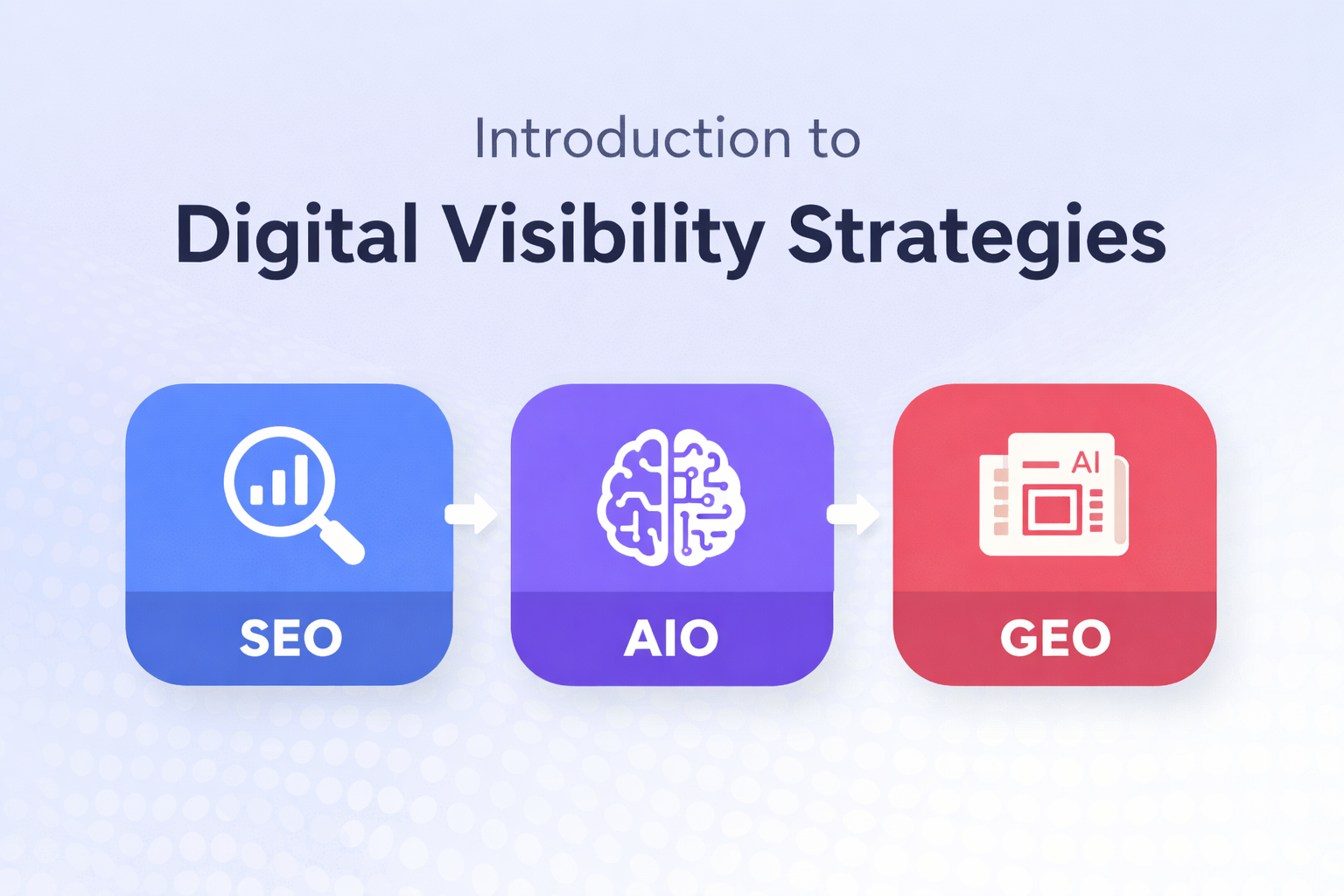
Introduction to Digital Visibility Strategies SEO, AIO, and GEO
Digital visibility no longer depends on search engines alone. Today, people discover information through traditional Google results, AI-generated summaries, voice assistants, and conversational tools like ChatGPT and Gemini. As this shift accelerates, businesses that rely only on classic SEO are beginning to see diminishing returns.
At the center of this evolution are three interconnected strategies: Search Engine Optimization (SEO), Artificial Intelligence Optimization (AIO), and Generative Engine Optimization (GEO). Each plays a distinct role in how content is discovered, interpreted, and ultimately presented to users. Understanding how these strategies differ — and how they work together — is becoming essential for sustainable online visibility.
SEO remains the foundation, AIO adapts content for AI understanding, and GEO determines whether that content is selected and surfaced inside AI-generated answers. Together, they define how search works today and where it is headed next.
The Foundations of Traditional SEO
Search Engine Optimization (SEO) continues to be the structural backbone of digital marketing. Its purpose is straightforward: help search engines understand, rank, and display web pages for relevant user queries. Core SEO practices revolve around keywords, backlinks, and technical performance, all of which influence how search engines evaluate content.
Keywords reflect how users express intent. Effective SEO starts by identifying not just high-volume terms, but phrases that match real search behavior. When keywords are integrated naturally into content, headings, metadata, and URLs, they help search engines determine relevance without compromising readability.
Backlinks act as credibility signals. Search engines treat high-quality links as endorsements, indicating that content is trustworthy and authoritative. While backlink strategies remain important, their influence is increasingly contextual rather than absolute, especially as AI-driven systems evaluate content quality more holistically.
Technical SEO ensures that content can be accessed efficiently. Page speed, mobile responsiveness, structured site architecture, schema markup, and crawlability all contribute to how well content performs. Without a solid technical foundation, even high-quality content struggles to gain visibility.
SEO still matters — but on its own, it is no longer enough.
Understanding AI Optimization (AIO)
Artificial Intelligence Optimization (AIO) focuses on how content is interpreted by AI systems rather than how it ranks on a results page. Unlike traditional SEO, which targets algorithms that rank links, AIO targets systems that read, understand, summarize, and recommend information.
Modern AI models rely on semantic understanding rather than exact keyword matching. This means clarity, structure, and context matter more than repetition. Content optimized for AIO is written in a way that AI can confidently extract meaning from it, identify key ideas, and associate those ideas with relevant user intent.
AIO places strong emphasis on natural language, clear definitions, and logical content flow. Techniques such as structured data, entity clarity, and conversational phrasing help AI systems process information accurately. This is especially important for voice search, AI summaries, and conversational queries, where users expect direct and reliable answers.
In practical terms, AIO ensures that content is not just visible, but understandable to machines that increasingly control how information is delivered.
Exploring Generative Engine Optimization (GEO)
Generative Engine Optimization (GEO) represents the next layer of visibility. While SEO helps content get indexed and AIO helps it get understood, GEO determines whether content is selected, summarized, and cited by generative AI systems.
GEO is designed for environments where users may never see a traditional search results page. Instead, AI generates a direct answer — often pulling from multiple trusted sources. Content that performs well under GEO is written to be quotable, authoritative, and context-rich.
Rather than focusing on ranking positions, GEO focuses on eligibility. AI systems favor content that explains concepts clearly, answers questions directly, and demonstrates topical authority. Well-structured paragraphs, concise explanations, and strong contextual signals increase the likelihood that content will be used in AI-generated responses.
In this sense, GEO acts as a bridge between human expertise and AI output, ensuring that original content is not only indexed, but actively used in generative answers.
The Interplay Between SEO, AIO, and GEO
SEO, AIO, and GEO are not competing strategies — they are layered ones. SEO ensures discoverability, AIO ensures comprehension, and GEO ensures selection.
SEO provides the technical and structural base that allows content to exist within search ecosystems. AIO builds on that base by aligning content with how AI systems analyze language, intent, and relevance. GEO then determines whether that content becomes part of AI-driven answers rather than remaining a passive web page.
For businesses, this means success no longer comes from optimizing for a single system. Visibility now depends on how well content performs across multiple discovery layers — from traditional rankings to AI summaries and conversational responses.
The Role of User Intent and Contextual Clarity
User intent is the common thread connecting SEO, AIO, and GEO. Search engines and AI systems are increasingly focused on understanding why a user is searching, not just what they are searching for.
Content that aligns with intent answers questions clearly, avoids ambiguity, and provides immediate value. Contextual clarity plays a crucial role here. AI systems prefer content that explains concepts directly, avoids unnecessary complexity, and maintains consistent terminology throughout.
Building topical authority through comprehensive coverage and logical structure helps both users and AI systems trust the content. When intent and clarity align, content becomes easier to rank, easier to summarize, and easier to recommend.
When to Use SEO, AIO, and GEO
SEO is most effective when building long-term organic visibility and establishing foundational authority. It remains essential for blogs, service pages, and evergreen content that benefits from sustained traffic. AIO becomes critical when content needs to perform well in AI-driven environments, including voice assistants, recommendation engines, and conversational tools. It is especially relevant for educational content, thought leadership, and informational resources. GEO is indispensable when the goal is to appear directly inside AI-generated answers. Businesses targeting future search behavior, zero-click searches, and AI discovery should prioritize GEO alongside SEO and AIO.
The strongest strategies do not choose between them — they integrate all three.
Future-Proofing Your Content Strategy
Future-proof content is built for interpretation, not just indexing. This means writing with clarity, intent, and structure while anticipating how AI systems will extract and reuse information.
SEO foundations should be maintained, but enhanced with semantic depth and natural language clarity. AIO practices help content remain adaptable as AI models evolve. GEO ensures that content remains visible even as search shifts away from traditional results pages.
Businesses that adopt this layered approach are better positioned to survive algorithm updates, AI-driven shifts, and changing user behavior without relying heavily on backlinks or paid visibility.
Conclusion: The Evolving Search Ecosystem
The future of search is not defined by rankings alone. It is defined by understanding, selection, and relevance. SEO ensures content is found, AIO ensures it is understood, and GEO ensures it is chosen.
As search ecosystems continue to evolve, businesses that align their content with all three strategies will gain a significant advantage. Those who adapt early will not only maintain visibility but become trusted sources within AI-generated search experiences.
In an environment where answers matter more than links, clarity, authority, and intent are the new ranking factors.
Frequently Asked Questions
1. What is the main difference between SEO, AIO, and GEO?
SEO focuses on rankings, AIO focuses on AI comprehension, and GEO focuses on whether content is selected and used inside AI-generated answers.
2. Is SEO still effective in 2026?
Yes, SEO is still effective, but it must be combined with AIO and GEO to remain competitive in AI-driven search environments.
3. What does AIO mean in digital marketing?
AIO stands for Artificial Intelligence Optimization and refers to optimizing content so AI systems can understand, interpret, and summarize it accurately.
4. What is GEO optimization in simple terms?
GEO optimization ensures that content is eligible to be cited or summarized by AI tools like Google AI Overviews and conversational search engines.
5. Can content rank without backlinks using GEO and AIO?
Yes, content can rank without backlinks if it demonstrates strong topical authority, clarity, and relevance that AI systems trust.
6. How does Google AI Overview choose content?
Google AI Overview selects content that is clear, authoritative, well-structured, and aligned with user intent rather than relying only on backlinks.
7. Is GEO replacing SEO?
No, GEO is not replacing SEO. GEO builds on SEO by optimizing content for AI selection rather than traditional ranking alone.
8. What type of content benefits most from AIO?
Educational content, guides, comparisons, and thought leadership pieces benefit the most from AIO because AI systems frequently summarize them.
9. How do I optimize content for AI search results?
Optimize for AI search by writing clear definitions, answering questions directly, maintaining contextual clarity, and structuring content logically.
10. Should small businesses focus on GEO?
Yes, small businesses benefit from GEO because AI-driven search reduces dependence on backlinks and favors clear, authoritative content.