

Google February 2026 Discover Update: What Publishers Need to Know
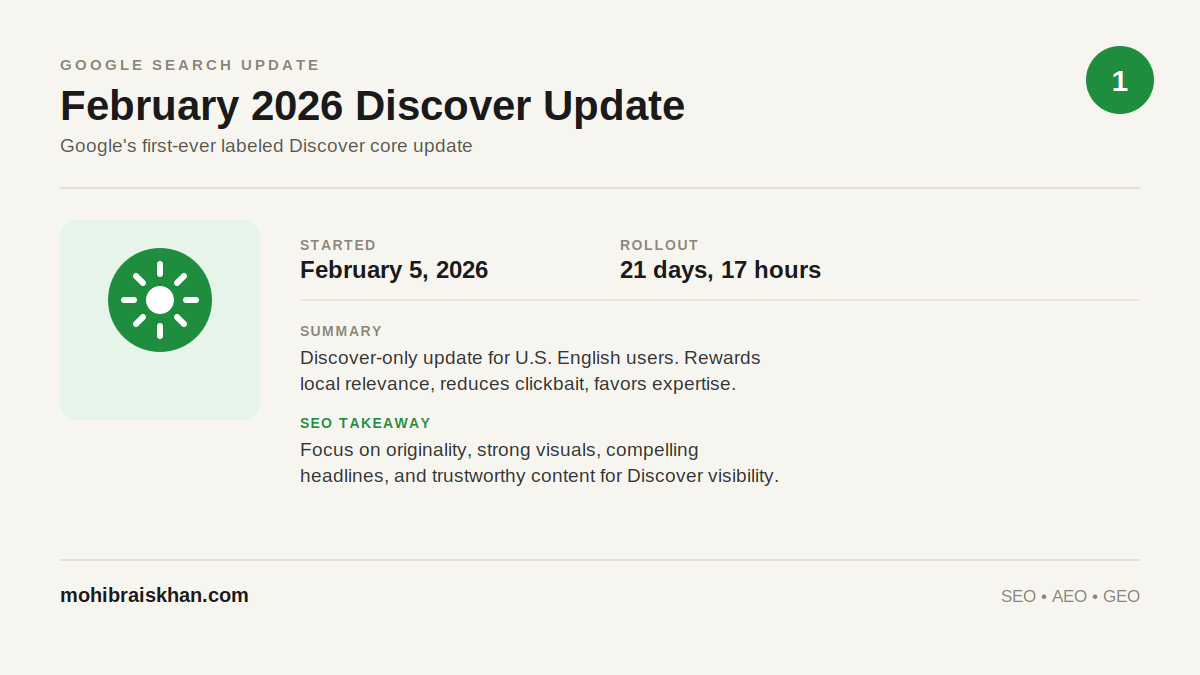
Google’s February 2026 Discover update rolled out from February 5 to February 27, and it was the first time Google publicly labeled a core update as a “Discover core update,” a broad change to the systems that surface articles in Google Discover rather than in regular search results. If your traffic includes a meaningful share from Discover, this is the update most likely behind any shift you saw in late February.
What Google Announced
Google made Google’s own announcement on its Search Central Blog on February 5, 2026, writing: “This is a broad update to our systems that surface articles in Discover. Our testing shows that people find the Discover experience more useful and worthwhile with this update.” Google said the change would improve the Discover experience in three specific ways: showing more locally relevant content from websites based in a user’s country, reducing sensational and clickbait content, and highlighting more in-depth, original, and timely content from sites with demonstrated topic expertise.
Google specifically noted that expertise is evaluated on a topic-by-topic basis, so a site with deep focus on one subject has the same opportunity to appear in Discover as a site with broader expertise across many subjects. As with any core update, Google warned to expect fluctuations: “Some sites might see increases or decreases; many sites may see no change at all.”
| Detail | February 2026 Discover Update |
|---|---|
| Rollout dates | February 5 – February 27, 2026 |
| Duration | ~22 days (8 days longer than Google’s estimate) |
| Scope | English-language users in the US initially; global rollout to follow |
| Affects | Google Discover only, not regular Search results |
| First of its kind | First update Google publicly labeled a “Discover core update” |
Rollout and Scope
The rollout took about 22 days, roughly 8 days longer than Google’s original two-week estimate, and finished on February 27. Unlike most core updates, which affect both Search and Discover, this update targeted Discover exclusively; Google explicitly noted that ongoing volatility in regular Search results at the time was unrelated to this rollout. Initially, the update applied only to English-language users in the United States, with Google saying it would expand to other countries and languages in the months ahead.
What Early Data Showed
Independent analysis after the rollout found a drop in the number of unique domains appearing in top Discover placements, combined with Discover covering a similar or broader range of topics overall. Read together, that suggests the update concentrated top placements among a narrower set of publishers even as the range of subjects covered stayed the same or grew, a pattern consistent with Google’s stated goal of favoring sites with demonstrated topical expertise over broader but shallower coverage.
The update also landed at a moment when Discover’s importance to publishers was already rising sharply. An analysis of more than 400 news publishers found Discover’s share of Google-sourced traffic had nearly doubled in two years, from 37% in 2023 to roughly 68%, while traditional web search traffic to the same publishers fell from 51% to about 27% over the same period. That context is part of why a Discover-only algorithm change carries real revenue weight for publishers even though it leaves standard search rankings untouched.
What to Do If Your Discover Traffic Changed
Google’s guidance for this update is the same as its general core-update advice, as well as the general guidance Google gives after a May 2026 core update, plus its dedicated “Get on Discover” documentation. There’s no specific fix guaranteed to reverse a Discover traffic drop. Given what the update targeted, the practical checklist is: confirm your content isn’t reliant on sensational headlines or clickbait framing, since Google explicitly said it’s reducing that in Discover; make sure you’re publishing genuinely original and timely material rather than aggregated summaries; and if your audience is concentrated in a specific country, ensure your content reflects clear local relevance and context, since that’s one of the three factors Google named directly.
Track Discover performance separately from regular search performance in Search Console rather than blending the two, since this update affected only one of those channels. Google also recommends waiting at least a week after a core update completes before drawing firm conclusions from the data, since Discover traffic in particular can be noisy in the days immediately following a rollout.
Check Your Site Against This Update With a Free Audit
Reading about what changed in an update is one thing; knowing whether it actually affected your site is another. Every Google update in 2026 has rewarded a similar set of signals: original content, clear local relevance, and pages that reflect real expertise rather than aggregation. Most site owners have no easy way to check where their own pages stand against those signals until traffic already drops.
audit.mohibraiskhan.com runs a free SEO, GEO, and AEO audit of your site in about 15 seconds and gives you a downloadable PDF report. For an update like this one, that matters because the audit checks the same fundamentals Google is now weighing more heavily: content depth and originality, technical crawlability, structured data and schema, and how well your pages are set up to be cited by AI answer engines as well as ranked in traditional search. Instead of guessing whether the February 2026 Discover update affected you, you get a concrete, prioritized list of what to fix.
It is free, requires no signup, and takes less time to run than it took to read this article.
Frequently Asked Questions
What was the Google February 2026 Discover update?
It was the first update Google publicly labeled a “Discover core update,” a broad change to the systems that select and surface articles in Google Discover. It ran from February 5 to February 27, 2026, and did not affect regular Search results.
What did the update change?
Google said it would show more locally relevant content based on a site’s country, reduce sensational and clickbait content, and highlight more in-depth, original, timely content from sites with demonstrated topic expertise, evaluated topic-by-topic.
Did this update affect regular Google Search rankings?
No. Google explicitly said this update targeted only Discover, and that any volatility in regular Search results during the same period was unrelated.
What should publishers do if their Discover traffic dropped?
Review content for sensationalism or clickbait framing, prioritize original and timely material over aggregated content, add clear local relevance where applicable, and track Discover performance separately from search performance in Search Console.
Free SEO audit · No signup
Reading about SEO is good. Knowing your score is better.
Run a free SEO + GEO + AEO audit of your website — results in about 15 seconds, downloadable as a PDF.