

Google May 2026 Core Update: Full Breakdown
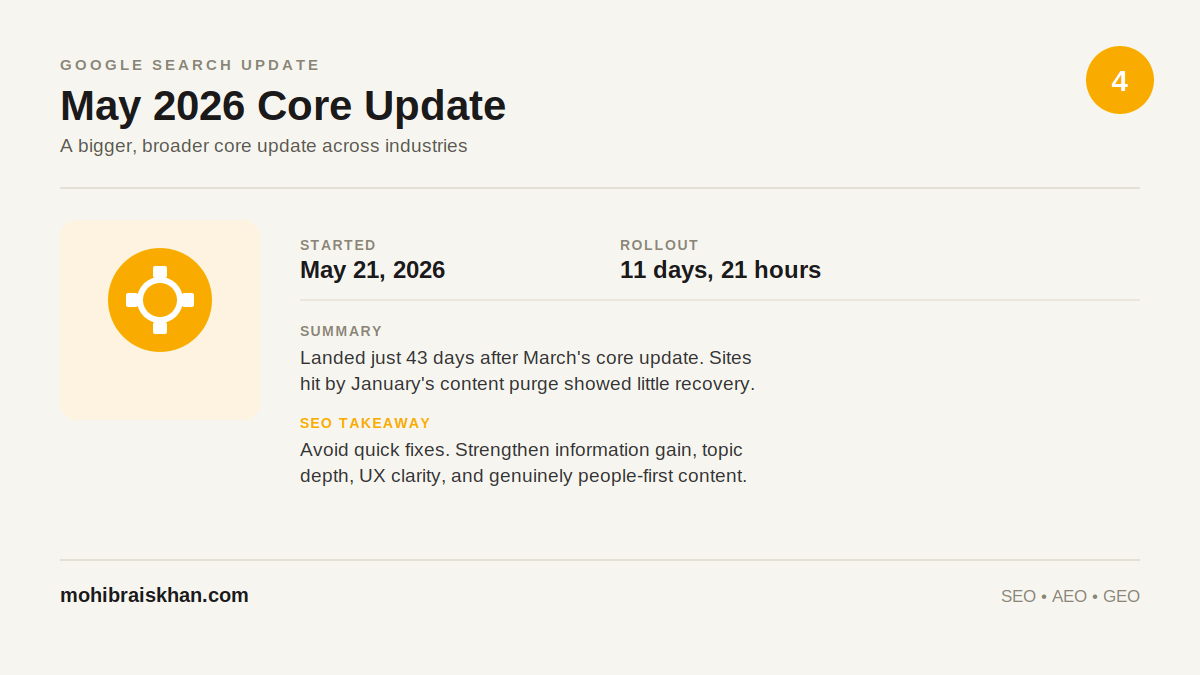
Google’s May 2026 core update ran from May 21 to June 2, its second broad core update of the year and, by most accounts, a bigger one than the March update that preceded it. It landed just 43 days after March’s core update closed out, one of the shortest gaps between broad core updates in recent years, which meant many sites were still adjusting to the previous shift when this one arrived.
Timeline and Rollout
Google announced the update on May 21, 2026, describing it with its standard language: “This is a regular update designed to better surface relevant, satisfying content for searchers from all types of sites.” The rollout took just under 12 days, completing on June 2. Volatility didn’t wait for the rollout to finish; significant ranking movement was already visible by Saturday, May 23, just two days in, and further large swings followed the next weekend, May 30, with more volatility recorded in the 24 hours before Google marked the update complete. Updates like this weigh heavily on high-stakes topics such as law, and my SEO for law firms 2026 guide covers how to build pages that hold up through them.
That pattern, real movement appearing early and continuing right up to completion, is one signal analysts pointed to as evidence this was a more substantial update than March’s. Semrush’s own volatility tracking showed clear spikes across the 30-day window, consistent with sitewide ranking shifts rather than isolated, query-specific noise.
| Detail | May 2026 Core Update |
|---|---|
| Rollout dates | May 21 – June 2, 2026 |
| Duration | ~12 days |
| Scope | Global, all languages |
| Order in 2026 | Second core update of the year |
| Gap since prior core update | 43 days (unusually short) |
| Relative strength | Larger than March 2026 core update, per early observation |
What the Update Appeared to Reward
One detailed independent analysis, which pulled eight continuous weeks of Search Console data and ran a page-level before-and-after comparison, found the update devalued exactly the type of content many site owners had already identified as low-value and rewarded exactly the type they were already trying to produce more of. In effect, the update accelerated a pruning process some sites were already undertaking rather than reversing their strategy. Pruning of this kind tends to line up with the work sites do for AIO and GEO, where fewer, clearer pages are easier for AI systems to cite.
Separately, analysts checking whether sites hit by the unconfirmed January 2026 “commodity content” purge had recovered by May found little evidence of recovery. Sites that lost visibility in January for relying heavily on scaled, lower-quality content, including AI-generated listicles, generally had not regained it by the time the May update completed, and in some cases saw further declines, particularly in Google’s Top Stories feature.
The update also landed in a notable context: the same week, Google confirmed at I/O 2026 that AI Mode had passed one billion monthly users and introduced autonomous “Search agents,” while follow-up queries within AI Mode had risen more than 40% month-over-month. That broader shift toward multi-step, conversational search sessions frames why Google continues recalibrating what counts as genuinely useful content rather than content merely optimized to rank.
What to Do If You Were Impacted
Google shared no update-specific guidance for May, repeating its standard position: a negative ranking impact doesn’t necessarily mean something is wrong with your pages, there’s no specific fix guaranteed to reverse a drop, and the biggest recoveries tend to follow a subsequent core update rather than immediate changes. Google continues to point site owners to its published questions for assessing content quality after a core update rather than offering a checklist unique to this rollout.
Given what the available analysis shows, the practical read is this: if your traffic dropped and your site relies on scaled or lower-effort content, don’t expect recovery without a real change in approach, since sites in that category weren’t recovering as of the May update. If your traffic dropped despite genuinely original, well-researched content, the standard core-update advice applies, review for underlying quality issues, but don’t panic into unnecessary rewrites.
Check Your Site Against This Update With a Free Audit
The May update reportedly hit harder than March, and analysts found that sites relying on scaled or lower-effort content had not recovered by the time it finished rolling out. Most site owners have no easy way to tell whether their own pages fall into that category until a core update has already moved their traffic.
audit.mohibraiskhan.com runs a free SEO, GEO, and AEO audit of your site in about 15 seconds and gives you a downloadable PDF report. For an update like this one, that matters because the audit checks the fundamentals core updates weigh most heavily: content depth and originality, information gain, technical crawlability, and structured data, the same signals that separated sites that recovered from sites that did not after May. Instead of waiting for the next core update to find out where you stand, you get a concrete, prioritized list of what to fix.
It is free, requires no signup, and takes less time to run than it took to read this article.
Frequently Asked Questions
What was the Google May 2026 core update?
Google’s second broad core update of 2026, running from May 21 to June 2. It recalibrated content-quality assessment across Google’s index and was widely reported as more impactful than the March 2026 core update.
How does the May 2026 core update compare to March’s?
It’s generally regarded as bigger and more volatile. It also arrived just 43 days after the March update closed, one of the shortest gaps between core updates in recent years.
Did sites hit by the January 2026 content purge recover in May?
Largely no. Analysts tracking sites affected by the earlier, unconfirmed January purge of scaled AI content found little evidence of recovery by the time the May update finished, with some sites seeing further declines.
What should I do if my site was hit?
Google offers no specific fix for this update. If your content relies on scaled or lower-effort production, expect no recovery without a genuine quality change. If your content is already original and well-researched, follow Google’s core update guidance review questions rather than making reactive changes.
Free SEO audit · No signup
Reading about SEO is good. Knowing your score is better.
Run a free SEO + GEO + AEO audit of your website — results in about 15 seconds, downloadable as a PDF.