

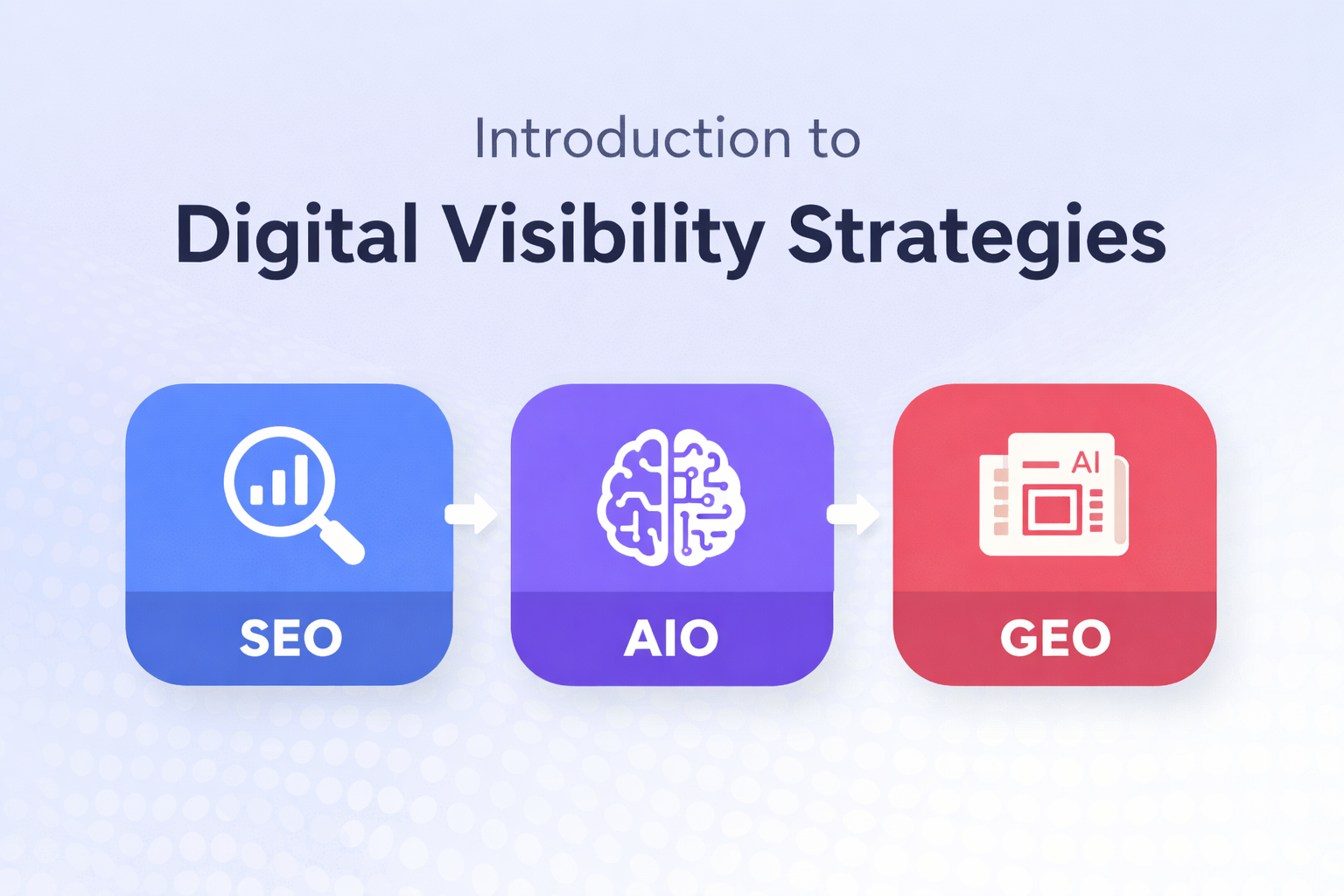
GEO, SEO and AIO: Understanding the Three Visibility Strategies
Digital visibility no longer depends on search engines alone. Today, people discover information through traditional Google results, AI-generated summaries, voice assistants, and conversational tools like ChatGPT and Gemini. As this shift accelerates, businesses that rely only on classic SEO are beginning to see diminishing returns.
At the center of this shift are four overlapping terms: Search Engine Optimization (SEO), Answer Engine Optimization (AEO), Generative Engine Optimization (GEO) and Artificial Intelligence Optimization (AIO). People who search “AIO vs GEO” usually want to know one thing: are these different jobs, or new names for the same work? This guide answers that, puts all four side by side, and separates what Google has actually said from what marketers claim.
AIO vs GEO: the short answer
AIO (AI optimization) is the broad goal: making your content and your business information easy for any AI system to read, understand and describe correctly. GEO (generative engine optimization) is a narrower goal inside it: getting your brand mentioned, or your page cited, when an engine such as Google AI Overviews, ChatGPT search or Perplexity writes an answer. SEO is still the base both depend on, because most AI answers are assembled from pages a search index has already found and ranked. AEO sits between them: shaping content so it can be lifted out as a direct answer, from featured snippets to voice assistants.
In practice the overlap is large. Most of the work that improves GEO and AIO is ordinary SEO done carefully. The real differences are in what you aim for and how you measure it.
SEO, AEO, GEO and AIO side by side
| SEO | AEO | GEO | AIO | |
|---|---|---|---|---|
| Main goal | Rank pages in search results | Be the direct answer to a question | Be mentioned or cited in AI-generated answers | Be understood and described accurately by AI systems |
| Where it shows up | Blue links, local pack | Featured snippets, People Also Ask, voice answers | Google AI Overviews and AI Mode, ChatGPT search, Perplexity | Any AI tool that summarizes or recommends a business |
| Core work | Technical health, relevant content, links from relevant sites | Clear question-and-answer sections, concise definitions | Specific, original, well-sourced content and a consistent brand across the web | Consistent business details, structured data that matches the page, plain language |
| How you measure it | Clicks, impressions and positions in Search Console | Which snippets and People Also Ask answers show your page | Mentions, citations and how you are positioned against competitors | Whether AI tools describe your business correctly |
| Is it new? | No | Grew out of featured snippets and voice search | Recently named; builds on SEO | An umbrella term, loosely defined |
The Foundations of Traditional SEO
Search Engine Optimization (SEO) continues to be the structural backbone of digital marketing. Its purpose is straightforward: help search engines understand, rank, and display web pages for relevant user queries. Core SEO practices revolve around keywords, backlinks, and technical performance, all of which influence how search engines evaluate content.
Keywords reflect how users express intent. Effective SEO starts by identifying not just high-volume terms, but phrases that match real search behavior. When keywords are integrated naturally into content, headings, metadata, and URLs, they help search engines determine relevance without compromising readability.
Backlinks act as credibility signals. Search engines treat high-quality links as endorsements, indicating that content is trustworthy and authoritative. While backlink strategies remain important, their influence is increasingly contextual rather than absolute, especially as AI-driven systems evaluate content quality more holistically.
Technical SEO ensures that content can be accessed efficiently. Page speed, mobile responsiveness, structured site architecture, schema markup, and crawlability all contribute to how well content performs. Without a solid technical foundation, even high-quality content struggles to gain visibility.
SEO still matters — but on its own, it is no longer enough.
Answer Engine Optimization (AEO): the question-and-answer layer
AEO predates the current AI wave. It grew out of featured snippets, People Also Ask boxes and voice assistants, where a search engine shows one answer above the results or reads it aloud. The work is structural: put a direct one- or two-sentence answer right under the question, then expand. Use headings that match how people actually phrase the question, and keep definitions self-contained so they still make sense when lifted out of the page.
Because AI answers also favor clear, self-contained passages, good AEO tends to help GEO as well. For a closer look at where those two part ways, see our SEO vs AEO vs GEO breakdown.
Understanding AI Optimization (AIO)
Artificial Intelligence Optimization (AIO) focuses on how content is interpreted by AI systems rather than how it ranks on a results page. Unlike traditional SEO, which targets algorithms that rank links, AIO targets systems that read, understand, summarize, and recommend information.
Modern AI models rely on semantic understanding rather than exact keyword matching. This means clarity, structure, and context matter more than repetition. Content optimized for AIO is written in a way that AI can confidently extract meaning from it, identify key ideas, and associate those ideas with relevant user intent.
AIO places strong emphasis on natural language, clear definitions, and logical content flow. Consistent business details, structured data that matches what is visible on the page, and plain phrasing help AI systems process information accurately. This matters for voice search, AI summaries and conversational queries, where users expect direct and reliable answers.
One naming note: in SEO circles “AIO” is also used as shorthand for Google’s AI Overviews. When you read about AIO, check which meaning the writer has in mind.
Exploring Generative Engine Optimization (GEO)
Generative Engine Optimization (GEO) represents the next layer of visibility. While SEO helps content get indexed and AIO helps it get understood, GEO determines whether content is selected, summarized, and cited by generative AI systems.
GEO is designed for environments where users may never see a traditional search results page. Instead, AI generates a direct answer — often pulling from multiple trusted sources. Content that performs well under GEO is written to be quotable, authoritative, and context-rich.
Rather than focusing on ranking positions, GEO focuses on eligibility. AI systems favor content that explains concepts clearly, answers questions directly, and demonstrates topical authority. Well-structured paragraphs, concise explanations, and strong contextual signals increase the likelihood that content will be used in AI-generated responses. Our full guide to generative engine optimization covers the tactics step by step.
Want to see how your own site scores on GEO? Run a free AI visibility check to measure exactly these signals — AI-crawler access, structured data, and answer-ready content — with your GEO and AEO scores in about 15 seconds.
What Google actually says about AI Overviews
A lot of GEO advice implies there is a separate trick for getting into Google’s AI features. Google’s own documentation says otherwise. Its guidance on AI features and your website states that there are no additional requirements to appear in AI Overviews or AI Mode, and no special optimization beyond normal SEO best practices. To be shown as a supporting link, a page has to be indexed and eligible to appear in Google Search with a snippet.
That has three practical consequences. First, technical SEO still decides eligibility: a page Google cannot crawl or index cannot be cited. Second, there is no special schema or file that unlocks AI Overviews; structured data helps only when it matches what is visible on the page. Third, the pages that get cited are usually the ones that already deserve to rank: specific, original and clearly written.
Other engines work differently. ChatGPT search and Perplexity run their own crawlers, so blocking those crawlers in robots.txt, or having a host that rejects them, can keep you out of their answers even while Google shows you normally. Checking that access is one place where GEO genuinely adds a task that classic SEO did not need.
The Interplay Between SEO, AEO, GEO and AIO
These are not competing strategies — they are layered ones. SEO ensures discoverability, AEO shapes the answer, AIO ensures comprehension, and GEO ensures selection.
SEO provides the technical and structural base that allows content to exist within search ecosystems. AIO builds on that base by aligning content with how AI systems analyze language, intent, and relevance. GEO then determines whether that content becomes part of AI-driven answers rather than remaining a passive web page.
For businesses, this means success no longer comes from optimizing for a single system. Visibility now depends on how well content performs across multiple discovery layers — from traditional rankings to AI summaries and conversational responses.
The Role of User Intent and Contextual Clarity
User intent is the common thread connecting all four. Search engines and AI systems are increasingly focused on understanding why a user is searching, not just what they are searching for.
Content that aligns with intent answers questions clearly, avoids ambiguity, and provides immediate value. Contextual clarity plays a crucial role here. AI systems prefer content that explains concepts directly, avoids unnecessary complexity, and maintains consistent terminology throughout.
Building topical authority through comprehensive coverage and logical structure helps both users and AI systems trust the content. When intent and clarity align, content becomes easier to rank, easier to summarize, and easier to recommend.
How to Measure SEO, AEO, GEO and AIO
Measuring each one separately is what stops the acronyms from turning into marketing noise.
- SEO: clicks, impressions and average position in Google Search Console, for the queries that bring buyers rather than just traffic.
- AEO: which featured snippets and People Also Ask answers show your page for a fixed list of priority questions. Check them by hand each month.
- GEO: run the same set of real customer questions in Google AI Mode, ChatGPT and Perplexity every month. Record three things separately: whether your brand is mentioned, whether your page is cited as a source, and how you are described against competitors. A brand can be mentioned without being cited, and cited without being recommended.
- AIO: ask AI tools to describe your business and check the facts, such as services, location and founding year. Wrong answers usually trace back to inconsistent details on your own site or on third-party profiles.
Search Console now also reports how often your pages appear in Google’s generative AI features, separately from standard results. On this site we track that figure weekly alongside ordinary impressions, because the two can move in different directions.
When to Prioritize Each One
SEO is most effective when building long-term organic visibility and establishing foundational authority. It remains essential for blogs, service pages, and evergreen content that benefits from sustained traffic. AEO pays off wherever your buyers ask clear questions, such as pricing, comparisons and how-to topics. AIO becomes important when content needs to perform well in AI-driven environments, including voice assistants, recommendation engines, and conversational tools. GEO matters most when the goal is to appear directly inside AI-generated answers, which is increasingly where zero-click research happens.
The strongest strategies do not choose between them — they treat SEO as the base and add the other three on top.
Future-Proofing Your Content Strategy
Future-proof content is built for interpretation, not just indexing. This means writing with clarity, intent, and structure while anticipating how AI systems will extract and reuse information.
SEO foundations should be maintained, but enhanced with semantic depth and natural language clarity. AIO practices help content remain adaptable as AI models evolve. GEO ensures that content remains visible even as search shifts away from traditional results pages.
Businesses that adopt this layered approach are better positioned to cope with algorithm updates, AI-driven shifts and changing user behavior.
If you want help applying this, my AEO services shape your content into direct answers, and my GEO services get your brand cited in AI-generated answers.
Conclusion: The Evolving Search Ecosystem
The future of search is not defined by rankings alone. It is defined by understanding, selection, and relevance. SEO ensures content is found, AEO shapes the answer, AIO ensures it is understood, and GEO ensures it is chosen.
The acronyms will keep multiplying. The work underneath them has changed less than the labels suggest: be findable, be clear, be specific, and keep your business described the same way everywhere. If you want a second pair of eyes on how your site shows up in both search and AI answers, see how we approach SEO and AI search optimization.
Frequently asked questions
What is the difference between AIO and GEO?
AIO (AI optimization) is the broad goal of making your content and business information easy for any AI system to understand and describe correctly. GEO (generative engine optimization) is the narrower goal of being mentioned or cited when an engine such as Google AI Overviews, ChatGPT search or Perplexity writes an answer. The two overlap heavily, and many people use the terms interchangeably.
What is the main difference between SEO, AEO, GEO and AIO?
SEO earns rankings, AEO earns direct answers such as featured snippets, GEO earns mentions and citations inside AI-generated answers, and AIO makes sure AI systems understand and describe you correctly.
Is SEO still effective in 2026?
Yes. Google’s AI Overviews and AI Mode draw on pages that are indexed and eligible to appear in Search, so SEO is still the foundation. AEO, GEO and AIO add goals and measurements on top of it.
What does AIO mean in digital marketing?
AIO usually stands for Artificial Intelligence Optimization: optimizing content so AI systems can understand, interpret and summarize it accurately. In SEO circles it is also used as shorthand for Google’s AI Overviews, so check which meaning a writer has in mind.
What is GEO optimization in simple terms?
GEO optimization makes content more likely to be cited or summarized by AI tools such as Google AI Overviews and conversational search engines.
Can GEO or AIO replace link building?
No. AI Overviews draw on pages that are indexed and eligible to rank in Google Search, so the signals that help a page rank, including links from relevant sites, still matter. Clear structure helps AI tools use your content, but it does not substitute for authority.
How does Google AI Overview choose content?
Google says there are no additional requirements or special optimizations for AI Overviews. A page must be indexed and eligible to be shown with a snippet, and beyond that Google’s normal ranking systems and quality guidance apply. Helpful, original, clearly written pages are the ones most likely to be used.
Is GEO replacing SEO?
No, GEO is not replacing SEO. GEO builds on SEO by optimizing content for AI selection rather than traditional ranking alone.
How do I optimize content for AI search results?
Write a direct answer under each question, use specific facts and examples, keep your business details consistent across the web, make sure AI crawlers are not blocked, and keep the page indexable.
Should small businesses focus on GEO?
Yes, as part of normal SEO rather than instead of it. For most small businesses the practical GEO work is consistent business information across the web, clear service pages that answer buyers’ questions, and genuine reviews, which are the same things that help local SEO.
Free SEO audit · No signup
Reading about SEO is good. Knowing your score is better.
Run a free SEO + GEO + AEO audit of your website — results in about 15 seconds, downloadable as a PDF.