

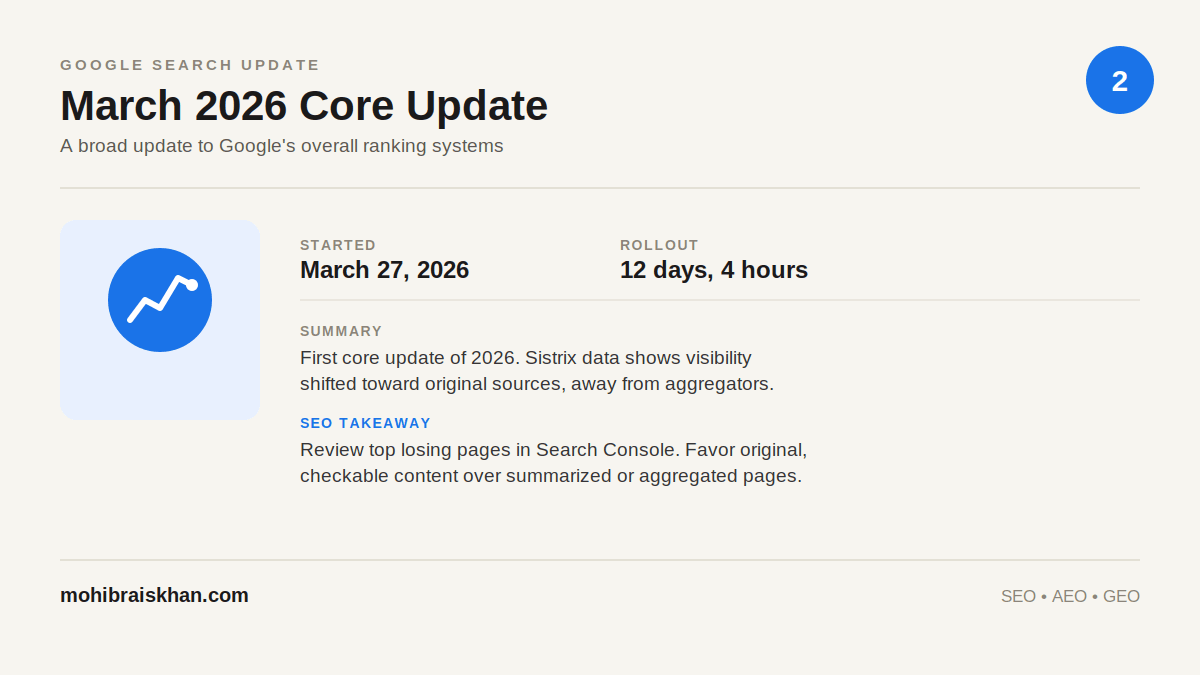
Google March 2026 Core Update: What Changed
Google’s March 2026 core update ran from March 27 to April 8, its first broad core update of the year. It followed the March 2026 spam update and the February 2026 Discover update, and by Google’s own account it was a weaker, less dramatic update than the one before it: real movement happened, but it was less powerful than the December 2025 core update that preceded it. If your rankings shifted in that window, the direction of the shift matters more than the fact of it, and independent analysis points to a specific pattern worth checking your site against. A core update like this is also a useful reality check on offers of search engine optimization guaranteed by contract: no provider controls Google’s timing, so the only guarantee worth signing covers the work and the response time.
Timeline and Basic Facts
Google announced the update on March 27, 2026, describing it in its usual language as “a regular update designed to better surface relevant, satisfying content for searchers from all types of sites.” The rollout ran 12 days and 4 hours, finishing on April 8 at 6:12 AM Pacific. That’s close to Google’s typical two-week estimate for core updates, and squarely in line with recent history.
Timing added a wrinkle: the March 2026 core update began rolling out just a day after the March 2026 spam update had finished. That overlap made attribution genuinely harder for sites that saw changes in late March, since a ranking shift in that window could plausibly trace to either update. According to analysis from SE Ranking, most of the volatility was likely driven by the core update, with the spam update amplifying the disruption rather than causing it independently.
| Detail | March 2026 Core Update |
|---|---|
| Rollout dates | March 27 – April 8, 2026 |
| Duration | 12 days, 4 hours |
| Scope | Global, all languages |
| Order in 2026 | First core update of the year |
| Preceded by | March 2026 spam update (1 day prior) |
| Relative strength | Weaker than Dec 2025 core update, per early observation |
What Actually Moved
Independent analysis from Aleyda Solis, using Sistrix data across the March 26 to April 11 window, found a consistent shift in where visibility concentrated rather than a random reshuffling. Official and institutional sites, specialist and niche publishers, established brands, and dominant platforms gained visibility. Aggregators, directories, and comparison-driven sites were the more common losers. Read together, the pattern suggests Google’s system moved trust and ranking weight away from intermediary sites, pages that exist mainly to summarize or compare what other sources already say, and toward sites that are the direct, original source of the information.
That lines up with what Google has said about core updates in general: they don’t target specific sites or tactics, they recalibrate how the systems assess content quality across the whole index. A directory or comparison site isn’t doing anything against Google’s policies; it can still lose visibility in a core update if Google’s model decides original, first-party sources now deserve more weight for the same queries.
What To Do If You Were Impacted
Google didn’t publish new guidance specific to the March 2026 core update. Its standing advice remains the same as with every core update: a ranking drop doesn’t necessarily mean something is wrong with your pages, there’s no specific fix to apply, and recovery, if it happens, more often comes with a future update than an immediate correction after you make changes. Google directs site owners back to its general core update guidance and helpful content questions rather than offering a checklist unique to this rollout.
Given what the Sistrix analysis found, the practical question worth asking is whether your content is a genuine primary source or functions mainly as an intermediary, aggregating, comparing, or summarizing information that exists elsewhere in more authoritative form. Pages that add real, checkable value beyond what’s already available, original data, direct expertise, first-hand experience, are the ones the March update appears to have rewarded. Pages that mainly repackage other sources are the ones more likely to have lost ground, independent of their technical quality.
How This Fits the Rest of 2026
The March 2026 core update was the first of what turned out to be a compressed 2026 update cadence: it was followed by the May 2026 core update just 43 days later, one of the shortest gaps between broad core updates in recent years. Sites that were still adjusting to March’s changes had limited time to stabilize before May’s update layered on further shifts. If you’re still seeing volatility that you attributed to March, it’s worth checking whether the May 2026 core update is a better explanation for changes that happened after early May.
Check Your Site Against This Update With a Free Audit
Core updates reward original, first-party content and move visibility away from intermediary and aggregator-style pages. Knowing that pattern in theory does not tell you where your own site actually falls on that spectrum, and most owners have no easy way to check until a core update has already moved their rankings.
audit.mohibraiskhan.com runs a free SEO, GEO, and AEO audit of your site in about 15 seconds and gives you a downloadable PDF report. For an update like this one, that matters because the audit checks the same fundamentals core updates weigh most heavily: content originality and depth, technical crawlability, structured data, and how well your pages are positioned to be treated as a genuine primary source rather than a summary of other sites. Instead of waiting to see if the next core update moves your traffic, you get a concrete, prioritized list of what to fix now.
It is free, requires no signup, and takes less time to run than it took to read this article.
Frequently Asked Questions
What was the Google March 2026 core update?
It was Google’s first broad core update of 2026, running from March 27 to April 8. It recalibrated how Google’s ranking systems assess content quality across the entire index, rather than targeting any specific policy violation.
How strong was the March 2026 core update compared to others?
Early observation suggested it was less powerful than the December 2025 core update, though it still produced meaningful movement. Its effects were also harder to isolate because it began just a day after the March 2026 spam update finished.
What kind of sites gained or lost visibility?
Independent Sistrix analysis found official and institutional sites, specialists, established brands, and dominant platforms gained visibility, while aggregators, directories, and comparison-driven sites were more likely to lose it.
What should I do if my site was hit?
Google offers no update-specific fix. Its standing advice is to focus on genuinely helpful, original content rather than reacting to a single update, since recovery tends to come with future updates rather than immediate changes.
Free SEO audit · No signup
Reading about SEO is good. Knowing your score is better.
Run a free SEO + GEO + AEO audit of your website — results in about 15 seconds, downloadable as a PDF.