

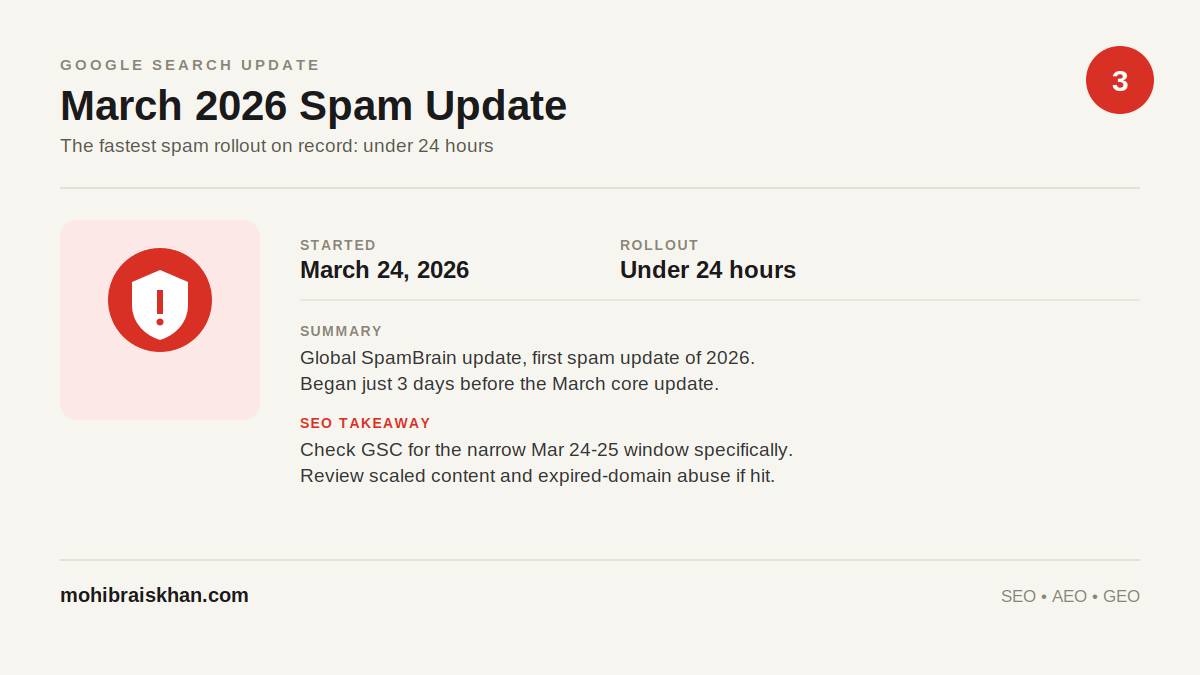
Google March 2026 Spam Update: What It Targets
Google’s March 2026 spam update rolled out on March 24 and finished in under a day, the fastest spam update rollout on record. It was the first spam update of 2026, following the February 2026 Discover update, and Google gave no indication at the time of exactly what it targeted, only that it was a routine improvement to its spam-detection systems.
Timeline and What Google Said
Google released the update on March 24, 2026 at 3:20 p.m. and confirmed it complete less than 24 hours later, on March 25. That speed was unusual: most spam updates take a few days to a few weeks to fully roll out, and this one was noticeably faster than typical. Google’s public statement was minimal, the same boilerplate language used for most spam updates: “This is a normal spam update, and it will roll out for all languages and locations.”
Because the rollout was so short, Google didn’t provide much of a window for third-party trackers to observe volatility in progress, which made this update harder to analyze in real time than slower rollouts. It’s also worth noting that the March 2026 spam update was followed just three days later by the March 2026 core update, which began March 27, so any lingering effects attributed to the spam update can be hard to separate from the core update that came right after it. Google released another spam update in June, and my breakdown of the June 2026 spam update covers what changed and how to check your own site.
| Detail | March 2026 Spam Update |
|---|---|
| Release date | March 24, 2026, 3:20 PM ET |
| Completion | March 25, 2026 (under 24 hours) |
| Duration | Fastest spam rollout on record at the time |
| Scope | Global, all languages |
| Order in 2026 | First spam update of the year |
| Followed by | March 2026 core update, 3 days later |
What This Update Targeted
Google did not specify which spam policies this update enforced, which is typical; Google rarely names specific targets for routine spam updates. What’s known is that it fits the same pattern as other 2026 spam updates: an improvement to SpamBrain, Google’s AI-based spam-detection system, rather than the introduction of any new spam policy category. Google’s general spam policies documentation covers the full range of tactics these updates can catch, including scaled content abuse, expired domain abuse, site reputation abuse, cloaking, sneaky redirects, and hidden text.
Given the update’s unusually fast rollout, it’s reasonable to infer it was a narrower, more targeted enforcement action rather than a sweeping overhaul, though Google never confirmed this directly. Sites not using manipulative tactics against Google’s spam policies had little reason for concern.
What to Do If You Were Affected
If you noticed a ranking or traffic shift around March 24 to 25, the tight window makes it easier to isolate than most updates, assuming the change didn’t also overlap with the core update that started three days later. Check your Search Console data specifically for that narrow window. A drop that appears and stabilizes within that single day points to the spam update; changes that continued moving into late March and early April likely trace instead to the core update. Overlapping updates like these are also why any pitch for guaranteed search engine marketing deserves a close read: nobody controls when Google rewrites the rules, so the only honest guarantee covers the work, not the ranking.
If the spam update is the more likely cause, review your site against Google’s spam policies documentation, with particular attention to scaled content abuse and any use of expired domains or reputation-borrowing tactics, since these are the categories Google’s automated systems have been most actively enforcing throughout 2026. As with any spam update, fixing genuine violations doesn’t produce an immediate recovery; Google’s systems need a period of months to recognize and reward the change.
Check Your Site Against This Update With a Free Audit
A fast-moving spam update like this one is easy to miss until traffic already drops, especially with a rollout window this narrow. Most site owners have no easy way to check whether their content resembles the scaled or low-value patterns SpamBrain is built to catch, until it is already too late to react quickly.
audit.mohibraiskhan.com runs a free SEO, GEO, and AEO audit of your site in about 15 seconds and gives you a downloadable PDF report. For an update like this one, that matters because the audit flags thin content, technical issues, and structural problems that can make a legitimate site look manipulative to automated spam detection, the same signals a spam update like this one is built to catch. Instead of waiting to see if a narrow-window update like this one caught your site, you get a concrete, prioritized list of what to check.
It is free, requires no signup, and takes less time to run than it took to read this article.
Frequently Asked Questions
What was the Google March 2026 spam update?
It was Google’s first spam update of 2026, released March 24 and completed in under 24 hours, making it the fastest spam rollout on record at the time. It followed the February 2026 Discover update.
How long did the March 2026 spam update take?
Less than 24 hours, from March 24 to March 25, 2026, an unusually fast rollout compared to typical spam updates that take several days to weeks.
Is the March 2026 spam update related to the March core update?
They’re separate updates, but closely timed: the March 2026 core update began just three days after the spam update finished, which can make it hard to isolate which one caused a given ranking change in late March.
What should I check if I was affected?
Pull Search Console data for the narrow March 24-25 window specifically. If a drop is contained to that period, review your site against Google’s spam policies documentation, particularly scaled content abuse and expired domain abuse.
Free SEO audit · No signup
Reading about SEO is good. Knowing your score is better.
Run a free SEO + GEO + AEO audit of your website — results in about 15 seconds, downloadable as a PDF.